| 
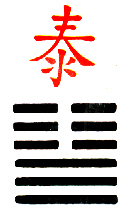
Above; earth the
passive
Below; heaven the creative.
The feminine creative
which moves downward is above; the male creative principal
which moves upward is below; thus they combine their
influence and produce harmony. All things flourish.
This is the hexagram of the first month of spring.
The small declines,
and the great and good is coming. Good fortune and
success.
Celestial and terrestrial
forces are in communion with each other and all things
move freely without restraint. High and low, superiors
and inferiors, are combined in social harmony and
sharing the same aims, are in harmony with each other.
Yang, representing strength, lies within; yin representing
joyous acceptance lies without. The Superior Man is
at the centre of things. His fortune steadily increasing
while those of mean nature are at the edges, declining
in their influence.
Heaven and earth
unite, forming Tai, the symbol of Peace (and Harmony).
In such a way a mighty ruler regulates the separate
ways of heaven and earth, marking the seasons and
the divisions of space. So he brings assistance to
people on every side.
Line 1
When the grass
is pulled up roots and sod come with it. Each in his
own way finds success in this enterprise.
In favourable times,
the man who is called to public service brings like-minded
people with him, whose common aim will be the welfare
of the people. Going forward according to a well-defined
plan will result in accomplishment.
Line 2
He deals gently
with the uncultured. Crosses the river without a boat.
Is dismayed by the distance and does not favour his
companions.
This is the way
to tread the middle path.
The Superior Man can find a use for everything, and
is not dismayed by the shortcomings of others, for
the great can make use even of the imperfect. Particularly
in prosperous times we must not hesitate to undertake
dangerous but necessary enterprises; at the same time
taking care not to join forces with others for mere
personal advantage.
Line 3
There is no plain
not followed by a hill, no departure not followed
by a return. He who persists in the face of danger
is without reproach. Do not despair at the inevitability
of change. A setback may be a blessing.
Bad things may
be conquered, but they are not destroyed, and may
return at any time. We should enjoy our good fortune
when we have it, but remain mindful of danger, so
that we may persevere against it. As long as a man
remains superior to what fate may bring him, fortune
will not desert him.
Line 4
He flutters down,
not boasting of his riches. Joins his neighbours,
frank and sincere.
In times of peace
and prosperity, those in high places mix with the
more lowly as equals. This is not pretended for reasons
of expediency, but is genuine unaffected spontaneity
which is based upon inner conviction. Those who are
virtuous can be either rich or poor.
Line 5
The emperor giving
his daughter in marriage. This brings blessings and
great good fortune.
The emperor’s
daughter, though of higher rank than her husband had
to defer to him like any other wife. So the emperor’s
benign action, bestowing his most precious possession
upon one of his subjects, brings fortune by its wise
and modest combination of high and low.
Line 6
The city all tumbles
into the moat. Now is not time for an army. Give orders
to your own people. Though this is the correct course
reproach cannot be avoided.
Peace is at an
end; the setback signaled in the third line of the
hexagram has come to pass. There is no advantage in
trying to hold off the evil moment by vain resistance;
it is better to try to organize a passive resistance
within one’s immediate circle. Nevertheless,
no matter how correct this behaviour may be, there
will still be cause for regret.
© 1979 Neil
Powell

Back
To Top

 Hexagram 12
 Hexagram 10
Back to Consult Page
Back to Link Page
I Ching Mainpage
|