| 
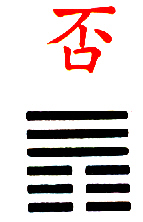
Above; Heaven the
creative
Below; Earth the passive.
This hexagram is
the opposite of Tai (11). Heaven is above moving further
and further away. Earth sinks below into the depths.
Pi is associated with the 7th month, when the year
is already in decline and the decadence of Autumn
is everywhere.
Stagnation. Evil
doers work against the perseverance of the Superior
Man. The great and good withdraw and the inferior
advances.
Heaven and Earth
are not in proper communion with each other and so
there is a lack of understanding between all kinds
of men. Matters do not have free course and conditions
are unfavourable to the firm and correct behaviour
of the Superior Man. The inner trigram is made of
weak yin lines, and the outer of strong yang lives.
So the way of the inferior appears to be increasing,
and that of the superior waning.
Heaven and Earth
stand divided, the image of stagnation. The wise man
withdraws into himself and conceals his true quality.
In this way he avoids the calamities that threaten
him, but he will not be rewarded or honoured.
Where lack of communication leads to chaos, disunion
or disharmony, things could reach a deadlock. It is
better to withdraw and find strength within. The road
to hell is paved with good intentions. Action leads
to misfortune.
Line 1
When the grass
is pulled up roots and the sod come with it. Each
in his own way find success by perseverance.
This text is almost
exactly the same as for the first line of Tai (11),
the preceding hexagram, but it has a very different
meaning. In place of the word ‘enterprise’,
we find ‘perseverance’ and the implication
is not of a man drawing others with him into public
service, but of one who persuades others to join him
in retirement.
Line 2
They suffer and
obey. Thus inferior people find good fortune. But
the Superior Man uses the time of stagnation to achieve
success.
Those in lower
positions would gladly be instructed by the wise man,
hoping that he could put an end to their confusion.
But he, since he cannot improve matters, does not
try. He keeps to himself and preserves his spiritual
strength.
Line 3
He conceals his
shame in his breast .
One of inferior
standing has seized power, but realizing that he has
no dominion over the people from amongst whom he has
risen, he feels the first stirrings of shame. He may
not admit his doubts in himself to others, but the
beginning of self-realization is the first step to
recovery. Those who grasp more than they can handle
soon realize their incapability. This is a healthy
sign.
Line 4
He who answers
a call from on high is without reproach. Those who
follow him will benefit.
The period of stagnation
is near its end, and conditions are about to change
for the better. The man who leads the people out of
the slough of the despond must feel the call like
the prophets of old. He must be competent, confident,
authoritative, and unpretentious.
Line 5
Stagnation is
coming to an end. There is great fortune for the great
man. What if we fail? What if we fail? Then bind it
to a clump of mulberry shoots.
When a mulberry
bush is cut back, strong shoots sprout from the base;
so the image of tying something to the shoots symbolizes
a way of making success certain. Still success is
uncertain, and caution is recommended.
Line 6
Stagnation is
ended. Stagnation began it, but now there is good
fortune.
This standstill
in the affairs of men does not come to an end of its
own accord. The right man is necessary to lead the
people out of the morass and confusion in which they
find themselves. This is the difference between a
condition of stagnation and a state of peace; constant
effort is needed to maintain peace, and if left to
itself it will decline into decadence and stagnation
again.
© 1979 Neil
Powell

Back
To Top

 Hexagram 13
 Hexagram 11
Back to Consult Page
Back to Link Page
I Ching Mainpage
|