| 
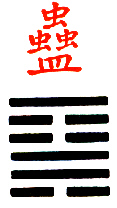
Above; Mountain.
Stillness
Below; wind, gentleness
The Chinese character
Gu, is said to represent ‘a bowl’, in
whose contents worms are breeding. This is because
the gentleness and indifference of the lower trigram
has been covered by the unmoving solidity of the upper
trigram. In these enclosed conditions the expected
result is stagnation, fermentation, and decay. But
just as natural decay can be controlled to provide
desirable fermentation products such as soy sauce
or rice wine, so the condition of decay represented
by Gu can be arrested and exploited.
Proper control
of decay affords progress and success. It is advantageous
to cross the great water. Three days before the beginning;
three days after.
“Crossing the great water” symbolizes
any important undertaking, whether it involves a journey
or not.
The passage; ‘three days before the beginning;
three days after’ has provoked much discussion.
In any properly controlled fermentation there is an
initial period before the process really begins to
work, and another period at the end of which it is
important to arrest fermentation.
The inception and growth of some new idea may therefore
be likened in many details to the process of fermentation.
In Gu, we have
the strong and immovable above, the weak and pliant
below. But control of the processes of decay leads
to good order everywhere under heaven. He who goes
firmly forward will come to business that must be
dealt with. The ending of confusion marks the beginning
of order.
Decay comes about due to neglect and abuse. This time
is a turning point and an opportunity to restore what
has deteriorated. Pay attention, take initiative,
and get to the root of things. The effort is rewarding.
The wind blows
at the foot of the mountain. The Superior Man, addressing
himself to the people, rouses them up and strengthens
his resolve.
Line 1
A son repairs
the errors of his father. A good son, redeeming the
reputation of his father. At first, danger, but in
the end good fortune.
The father is the
representative of convention and tradition, perhaps
the ruler of a state, who has allowed the vitality
of himself and his country to degenerate into mere
form and custom. The son symbolizes the vigour of
youth. A new leader who is able to revitalize the
state. But before he emerges there is great danger
that the existing system will destroy itself. Repair
is difficult but doable.
Line 2
A son repairs
the errors of the mother. But he should not be too
inflexible.
Here the errors
have not been committed by a strong man, but out of
weakness or careless indifference. In setting things
right, a degree of kindness and consideration is necessary.
Line 3
A son repairs
the errors of his father. There will be some remorse,
but no great blame.
Here the young
man has been too precipitate in arresting the processes
of decay, like one who has stopped the process of
fermentation of wine prematurely. But too much energy
is better than too little energy, and so, although
his hasty actions may cause him certain regrets, he
is free of reproach.
Line 4
The son condones
the errors of his father. Persisting he falls into
disgrace.
The significance
of this line lies in recognizing the processes of
decay, and in understanding the right moment at which
to bring them to a stop. The indulgent son who is
not confident enough to put right the mistakes of
the past will bring humiliation upon himself as well
as on his father. Laziness or indifference to the
task of putting things right brings reproach.
Line 5
The son repairs
the errors of his father and wins praise.
The fifth line
is the position of the ruler. The true leader receives
acclaim for his actions in arresting the process of
decay, particularly in that he also accepts responsibility
for the previous shortcomings of others.
Line 6
He does not serve
the emperor but seeks higher goals.
There are some
who do not feel themselves obliged to concern themselves
with worldly affairs, but who prefer to withdraw into
their private thoughts. This withdrawal is justified
when the Superior Man turns his mind to spiritual
matters. The purpose of the sage is not to redeem
the present but to create the values of the future.
© 1979 Neil
Powell

Back
To Top

 Hexagram 19
 Hexagram 17
Back to Consult Page
Back to Link Page
I Ching Mainpage
|