| 
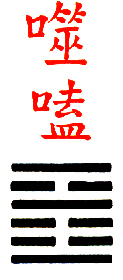
Above; fire, brightness
Below; Thunder and awakening
This hexagram is
thought of as representing a mouth. The yang line
in the fourth place is something through which the
teeth are biting. When this something has been bitten
through, the mouth will be closed, obstacles cleared
away and problems resolved.
She He signifies
successful progress. It is advantageous to seek justice.
Union is brought
about by biting through the intervening obstacles
and the hexagram indicates successful progress. Yang
and yin lines are equally divided in the figure. Thunder
and movement are denoted by the lower trigram, brightness
and intelligence by the upper.
Thunder and lightening are the manifestation of the
sudden release of built-up tensions in nature. A yin
line occupies the fifth place, the place of the ruler.
Although this not its proper position, it is advantageous
for the processes of law.
Thunder and lightening
are the symbol of biting through. The kings of old,
therefore, framed their laws with care, making the
punishment fit the crime.
Line 1
His feet are locked
in the stocks. His toes are gone. No reproach.
The interpretation
of this line has provoked much disagreement among
Chinese scholars. The first and sixth lines are considered
to represent the man who suffers punishment, the rest
represent whose who impose the penalties. For western
readers the stocks is only a mild form of punishment
and they have interpreted ‘his toes are gone’
as meaning the toes are hidden by the wooden beam
of the stocks. On the other hand, cutting off a man’s
toes was a specific Chinese punishment, and the penalty
described here may be a rather more severe one than
is generally supposed. But no matter whether the punishment
is light or severe, this line indicates plainly that
it is fully justified.
Line 2
Biting through
the tender meat his nose is gone. No reproach.
Again this line
is open to different interpretations. Some commentators
translate it as meaning that the subject is so concerned
to see justice done that he ‘cuts off his nose
to spite his own face.’ Others merely see the
nose hidden by the depth of the meat into which he
has bitten, meaning that he loses sight of clemency
in his pursuit of the wrong-doer. Again, however,
it is worth remembering that cutting off a felon’s
nose is a specific punishment. The verse makes it
clear that, although this may be too severe a penalty,
it is nevertheless without blame.
Line 3
Biting through
the dried meat he injures himself. There is some humiliation
but no reproach.
Here the punishment
is being carried out by someone without sufficient
power and authority. In performing this he does harm
to himself. However, since the punishment was necessary,
and he was performing his duty, he will soon recover
and will not be blamed.
Line 4
Biting through
dried gristle and bone he receives the arrows demanded.
It is advantageous to realize the difficulties for
perseverance brings good fortune.
In a civil law
case in ancient China, it was customary for the litigants
to bring to court a bundle of arrows. The case is
a hard one to judge, and it is only by recognizing
all the difficulties involved that one can find the
persistence to reach a just conclusion.
Line 5
Biting through
dried lean meat, He receives the gold required. Aware
of danger he perseveres without reproach.
In a criminal proceeding
it was customary for the litigants to deposit a sum
of gold before the hearing. The fifth line represents
the ‘lord of judgement.’ In his powerful
position he is inclined to be lenient. Although the
case is a difficult one, it is not too difficult.
If the judge remains conscious of the dangers involved
in making the wrong decision, his judgement will be
just. The yellow of gold is the colour of correctness
in the middle way.
Line 6
His neck is locked
in the wooden cangue. His ears are gone. Misfortune
Deaf to good counsel,
the felon is locked in the great block of the cangue,
( neck block) which he must carry about his neck until
his crime has been expiated. It may even be that he
has suffered the severest punishment of having his
ears cut off.
© 1979 Neil
Powell

Back
To Top

 Hexagram 22
 Hexagram 20
Back to Consult Page
Back to Link Page
I Ching Mainpage
|