| 
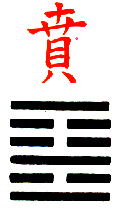
Above; Mountain,
stillness
Below; fire, brightness
A fire breaks out
from the depths of the earth, blazing up to illuminate
the heavenly heights of the mountain. The outer stillness
of the mountain, lit from within by the inspiration
of intelligence, is the symbol of Grace.
Bi indicates that
grace, impelled by brightness should be given a free
course. Even in minor matters it is advantageous to
go forward.
The weak yin line
rises between the two yang lines of the lower trigram,
adorning them with its brilliance. The alteration
of firmness and yielding is the pattern of heaven
itself. By contemplating the patterns of heaven we
begin to understand the changing seasons. As the earth
adorns heaven, and heaven the earth, so do the different
levels of society adorn one another, and by observing
them we can learn to live in Grace.
Fire below the
mountain is the symbol of Grace. The Superior Man,
observing this, throw light upon the processes of
government, but does not dare to intervene in the
processes of law.
Line 1;
He adorns his feet, leaves his carriage, and walks
in grace.
He who begins in
a subordinate position must learn to progress by his
own labours – to walk ‘on his own two
feet.’ He does not accept the easy assistance
offered by the carriage, but at the same time he makes
sure that he is properly shod for his undertaking.
Line 2;
He wears his beard with elegance.
A beard is the
sign of age and sagacity. He who wishes to associate
with his elders should conform to their customs. At
the same time, it must be remembered that a fine beard
on the chin of a young and inexperienced man is nothing
but adornment, and may indicate only vanity.
Line 3;
Adorned, he glistens with grace. Righteous perseverance
brings good fortune.
This is a very
pleasant situation. Life is good. There is every material
comfort. The phrase ‘gracious living’
exactly describes it. But such a state of affairs
can inly be maintained by perseverance in the true
way.
Line 4;
He is adorned but only in white. A white horse with
wings. One comes, not as a robber, but for a betrothal.
White is the colour
of simplicity, but also of funerals. The winged white
horse is the symbol of innocent belief transcending
the limits of time and space. The fourth line is the
bottom line of the upper trigram and finds its correlate
in the bottom line of the lower trigram, from which
it is separated by the strong third line. This is
the ‘robber’, who is really a man of good
reputation. He is anxious to ensure that the adornment
of the fourth line by the first is carried out according
to proper form.
Line 5;
There is grace in hills and gardens. His silk girdle
is thin and small. Disgrace, but in the end good fortune.
The Chinese loved
gardens and to own or visit one was a great privilege.
To be invited to walk in a great man’s garden
and then to appear poorly dressed could bring nothing
but humiliation and disgrace. Nevertheless, it is
a relatively small fault and even though it may be
attributed to meanness rather than poverty, in the
end all will be well.
Line 6;
Nothing but grace in white. No reproach.
At the highest
stage of development, true grace is to be found without
adornment. Simplicity is all.
© 1979 Neil
Powell

Back
To Top

 Hexagram 23
 Hexagram 21
Back to Consult Page
Back to Link Page
I Ching Mainpage
|