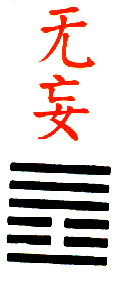
Above; Heaven
the creative
Below; Thunder and awakening
Wang is the symbol
of recklessness and insincerity. Wu Wang comprises
meanings that are almost the opposite of this. But
the innocence that is symbolized is so ingenuous,
so unsophisticated, that it retains one aspect of
the significance of Wang – a trace of the
unexpected.
Wu Wang indicates
integrity, and resultant success. Persistence in
righteousness brings its reward. But one who is
ot as he should be will suffer misfortune and none
of his undertakings will have a favourable outcome.
The strong first
line becomes part of an outer trigram of three yang
lines enclosing an inner trigram which is itself
ruled by a strong ling. The hexagram is full of
power and movement and strength. The fifth line
is a yang line, in the place of the ruler, and the
weak second line responds to it. He whose movement
follows the laws of heaven will be innocent and
without guile.
But correct action on the part of the subject will
lead to errors that cannot easily be put right.
In what direction should he move, even though he
sincerely and innocently believes in all he does?
What can he achieve if it’s not in accordance
with the will of heaven?
The thunder rolls
below the heavens, and all things find their true
nature free from all insincerity. So the kings of
old filled with virtue made their laws according
to the seasons and the ways of nature bringing abundant
nourishment to all humankind.
Clarity of purpose
and calm consideration generates a successful outcome.
Genuine spontaneity brings success. Ulterior purposes
bring misfortune.
Line 1
Protected by
his innocence and his integrity he achieves good
fortune.
The noble impulses
of the innocent heart are always good. We may follow
them with confidence. But one who is devious by
nature and who justifies his actions by false appeals
to honour, may flourish for a while but will suffer
failure in the end.
Line 2
Count not upon
the harvest while still ploughing. Nor upon the
third year’s crops before the first is in.
It is favourable to embark upon an undertaking.
As thou sowest,
so shalt thou reap. Don’t count your chickens
before they are hatched. Each task has its own time
and appointed place, and, each turns out well so
the next can be undertaken. But unwise anticipation
can only bring disappointment.
Line 3
An unexpected
misfortune. An untethered cow is her master’s
loss, the gain of a passer by.
Carelessness
or over-confidence is soon followed by calamity.
He who innocently places his trust in the honesty
of others may find himself the loser.
Line 4
Correct and
resolute he suffers no loss.
The open and
candid man of integrity must know when to call upon
his strength and resist the persuasion of others.
Line 5
Though he is
ill the fault is another’s. Without medicine
he will find joy in his recovery.
The difficulty
in which he finds himself is not of his own making.
But the result of some other’s mistake. He
should not try to remedy matters by external means
or experiment with some untried panacea. Quietly
and innocently he should let nature take its course.
Then the problem will solve itself.
Line 6
Unplanned, out
of season, a journey can only bring misfortune.
The time is only favourable for those with no destination
in mind.
When, in any
situation, the time and conditions are not right,
the wisest course is to wait quietly, making no
plans for the future. Trying to push ahead, opposing
oneself against fate, can only result in failure
© 1979 Neil
Powell


Back
To Top

 Hexagram 26
 Hexagram 24
Back to Consult Page
Back to Link Page
I Ching Mainpage