| 
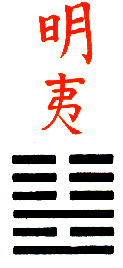
Above; Earth the
passive
Below; fire, brightness, beauty
The sun has sunk
beneath the earth. The name of the hexagram, Ming
Yi literally means ‘wounding of the bright.’
This hexagram comprises not only a transposition of
the trigrams of the previous hexagram, but is in fact,
its inversion. In Jin a wise man assisted by competent
helpers made steady progress. In Ming Yi the wise
man is in peril from a malevolent man in authority.
The light is sinking.
Righteous persistence in the face of adversity brings
advancement.
As the sun declines
into the earth, so its light is extinguished. Meet
adversity like King Wen, attiring your inner self
in refinement and intelligence, displaying gentleness
and compliance in your outward behaviour. Determined
to triumph over all difficulties, hide our light under
a bushel. Be like prince Qi who, with his troubles
locked up within his heart, fixed his whole being
upon righteousness with rigid determination.
The light sinks
into the earth, the image of Ming Yi. The Superior
Man, walking among the people, keeps his light hidden.
But still it shines.
Line 1
The light sinks
as he flies through the sky. His wings droop. For
three days, busy about his occasions, the Superior
Man goes without food or rest. Though his lord whispers
about it, he has no goal in view.
The emperor Yu
busied with the problems of controlling the floods,
frequently passed the door of his family home without
stopping to greet his relations. Confucious himself
is reported to have gone several days without stopping
for food. Nevertheless one who concerns himself too
much with mundane matters will be forced to withdraw
from obstacles too great to be surmounted. In spite
of everything, if he has a true goal in view, he will
be honoured, even though those above him in authority
criticize him for persistence.
Line 2
The light sinks.
Wounded in the thigh he saves himself by the strength
of a horse and brings assistance. Good fortune.
Though the Superior
Man conceals his light, he is harmed by the actions
of one in authority. But striving with all his strength,
he brings relief to the distress of others in a similar
plight.
Line 3
The light sinks
as he searches in the south. He captures the prince
of darkness. But foolish persistence must be avoided.
By good chance
and not by design, the wise man encounters and vanquishes
his principal enemy. But no matter how good his intentions
and right his cause, he was vulnerable and showed
excessive zeal that amounted to almost madness. Though
it is praiseworthy to struggle against adversity,
it is foolish to endanger oneself unnecessarily.
Line 4
Leaving his gate
and courtyard, he thrusts into the left of the belly
and exposes the heart of the prince of darkness.
The wise man has
exposed the true nature of his adversary. But performing
this deed as he sets out from his place of safety
he realizes that the evil is too great to cope with.
He withdraws even further from the scene.
Line 5
The light sinks
as it sank for Prince Chi. Righteous persistence is
rewarded.
Prince Qi lived
at the court of the Tyrant Ti-Hsin, who is clearly
the ‘prince of darkness’ referred to.
But although Prince Chi could not withdraw physically
from the court, he hid his true feelings and feigned
insanity. Treated as little more than a slave, he
did not allow his misery to deflect him from his belief
that the true light can never be extinguished.
Line 6
No light in the
darkness. After ascending to the heavens he plunged
into the depths of the earth.
The prince of darkness
is triumphant. But the darkness brings its own destruction
and in the end evil will be overcome.
© 1979 Neil
Powell
Back
To Top

 Hexagram 37
 Hexagram 35
Back to Consult Page
Back to Link Page
I Ching Mainpage
|