| 
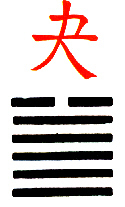
Above; A pool of
water, joy
Below; Heaven, the creative.
The strong yang
lines are rising resolutely upward through the hexagram
and cannot be restrained by the weak line at the top.
The result will be a breakthrough, like a cloudburst,
or a flooded river bursting its banks. The outcome
of such a breakthrough will be a resolution of the
state of tension that produced it. Guai is associated
with the third month of the year ( March-April) when
frequent rainstorms burst upon the land.
Everything should
be reported in full at the king’s court, even
though frankness is dangerous. When reporting to one’s
own city, it is not proper to be armed. It is good
to have a destination in view.
The strong resolve
the affairs of the weak. Strength is combined with
cheerfulness and determination is combined with placidity.
Reporting, possibly the guilt of a criminal, at the
king’s court is indicated by the single weak
line above the strong lines. The importance of a known
destination is also indicated by the way in which
the movement of these strong lines is brought to an
end.
The lake has risen
above the heavens. The image of Guai. The Superior
Man, accordingly, bestows his gifts upon those below
him. he does not rest upon his virtues.
Line 1
Might and proud
in his strength he advances his feet. But he is unequal
to the task and suffers humiliation.
In the Chinese,
the text employs much the same words as in the text
for the bottom line of hexagram 34 (Da Zhuang –
Strength of Greatness). There is a reference to advancing
with the toes. This represents an attempt to go forward
by sheer brute strength without proper consideration
to the means or to the outcome. In such circumstances,
one is likely to suffer a setback at the most damaging
moment.
Line 2
Shouts in the
night. But he who is forearmed is forewarned and has
no fear.
The Superior Man
is always on his guard and so, when there is an alarm,
he does not become excited and flustered. When reason
triumphs over fear, he treats difficulties as though
they did not exist. As he develops his strength of
character, so others submit to him without argument.
Line 3
Setting the jaw
and advancing straight forward brings misfortune.
The Superior Man determines on interception. Walking
alone in the rain he is splattered with mud. His friends
murmur against him. No blame.
In the struggle
against evil, the most obvious course is to set one’s
jaw firmly and nobly plunge forward. But this is not
wise. The wise man, although, his resolve is firm,
takes a way that will enable him to cut off the criminal
even though it may appear to be devious. Because of
this he will be misjudged and thought to be inferior.
but remaining true to himself and his faith, he will
make no mistake.
Line 4
His haunches are
flayed and he walks with difficulty. Letting himself
be led like a sheep he could put an end to his pain.
But though he hears this advice he believes it not.
Obstinately, the
man pushes forward, even though he suffers. He has
an inner drive that will not let him rest. This is
not the way. He should desist from his foolish course
and take the advice of others. But obstinacy deafens
a man to all good counsel.
Line 5
Like a bed of
weeds, tenacious but shallow rooted, inferior men
cling to the earth. The Superior Man, determined to
uproot them, treads the middle way and suffers no
reproach.
The inferior man
in a high position holds desperately to his place
and it takes dangerous determination to remove him.
but one must not be deflected from the true path.
Line 6
There is no warning.
The end is misfortune.
At the very moment
when victory appears to be in one’s grasp, a
moment of inattention can bring disaster.
© 1979 Neil
Powell
Back
To Top

 Hexagram 44
 Hexagram 42
Back to Consult Page
Back to Link Page
I Ching Mainpage
|