| 
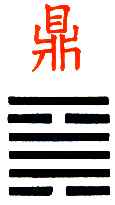
Above; Fire, brightness,
beauty
Below; Wind, gentleness, penetration
The hexagram is
the image of a cauldron; at the bottom are the legs,
above them the rounded belly, then the handles like
ears, and at the top the rim. The cauldron is the
symbol of the nourishment it contains, and it is also
the sacrificial vessel. It stands in the fire, fanned
by the wind.
Great good fortune and success.
The cauldron represents the peace and beauty indicated
by its two component tigrams, wood and fire combine
to cook the sacrificial offering. The sages of old
cooked their sacrifices in order to make them more
acceptable to the supreme being, and made lavish feasts
to nourish their wise and capable helpers. Ding is
the symbol of flexible obedience. Ears are made quick
of hearing and eyesight is sharpened. The weak yin
line enters and ascends to the fifth place, where
it responds to the strong yang lines below. All these
things indicate great progress and success.
Fire upon wood is the image of Ding. The Superior
Man., assuming a righteous posture, holds firmly to
the decree of heaven.
Line 1
The cauldron is
turned over.
To empty it of decaying meat
Taking a concubine to bear sons
Brings no blame.
Reversing the
normal order of things is acceptable when the reason
for the action is good. Although a concubine is regarded
as a lowly person, she should be honoured for the
sons she bears. Every person, no matter how inferior
his station, can gain recognition for his accomplishments
if he acts in an honourable way to better himself.
Line 2
The cauldron is
filled
And my friends are envious
but they cannot harm me
Good Fortune.
'My cup runneth
over", says the psalmist. The man who has obtained
some solid achievement will be the envy of everyone,
even his friends. But, armed with his spiritual strength,
he is unassailable.
Line 3
The handles of
the cauldron are broken
It cannot be moved
The fat pheasant goes uneaten
When sudden rains come
Regret fades away
And good fortune comes in the end.
This represents
a man whose abilities go unrecognized, and who is
therefore rendered ineffectual. All his good qualitities
are going to waste. But the unexpected rainstorm,
which cools the fire and the pot standing on it ,
is an omen of good fortune.
Line 4
The legs of the
cauldron are broken
The prince's dinner is spilled
And his garments splashed.
Misfortune.
Here is a man
not fit for his responsibilities. He is careless and
brings misfortune not only upon himself but upon his
superiors.
Line 5;
The cauldron has yellow handles
And a golden rim.
Righteous persistence brings its reward.
The problems indicated in the last two texts have
been resolved. The man in authority is unpretentious
and approachable. As a result he finds competent helpers.
But he must remain resolutely virtuous.
Line 6
The cauldron has
a rim of jade
Great good fortune
Everything is favourable.
In the preceeding
text, the rim of gold denotes strength and purity.
Jade is hard, but at the same time luminously lustrous.
The sage representd in the top line gives good advice
to all. He finds favour in the eyes of the supreme
being. He brings good fortune to everyone without
concern for his personal advantage.
© 1979 Neil
Powell
Back
To Top

 Hexagram 51
 Hexagram 49
Back to Consult Page
Back to Link Page
I Ching Mainpage
|