| 
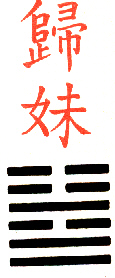
Above; Thunder
and awakening
Below; A pool of water, joy
The hexagram represents
the eldest son and the youngest daughter. the hexagram
represents the older man leading a young girl through
the door of his house. But the girl is not his first
wife. She is his second wife or perhaps the first
of his concubines. For this reason Gui Mei is not
a very fortunate omen, even though it should not be
taken as referring in every case to marriage.
Gui Mei is the
marriageable maiden. Going forward brings misfortune
and no destination is at present favourable.
This hexagram symbolizes the proper relationship between
heaven and earth. If heaven and earth had no intercourse,
nothing would come into existence and flourish. The
marriage of the younger sister is both her end and
her beginning. Joy and movement together is the image
of a maiden marrying. But the inappropriate positions
of the third and fifth lines indicate that going forward
will bring misfortune. The weak yin lines are mounted
upon the strong yang lines.
Thunder over water
is the image of Gui Mei. The Superior Man understands
the mischief that may be made at the beginning in
order to reach a lasting conclusion.
Line 1
The maiden marries
as a concubine
the lame man can still walk
going forward brings good fortune.
The girl who enters
a family in the position of first concubine is in
much the same position as a man who is appointed adviser
to a high minister. He has no power of his own, but
although this hampers his activities, he is still
able to advance both himself and the matters for which
he is responsible.
Line 2
The one eyed man
can still see The hermit can still advance himself
by righteous persistence.
A man who neglects
the affections of his concubine is like a man with
one eye. He is concerned only with his own interests.
But even the solitary person, man or woman, is not
without virtue.
Line 3
The maiden was
but a slave
And rose to become a concubine.
Desperate to improve one's position, one can take
the first opportunity that offers itself. But it is
likely to be only a small advance, one still implying
subservience.
Line 4
The maiden remains
unwed
Beyond the proper day.
But a late marriage comes in time.
A girl may delay her marriage, in expectation of finding
the right husband, until it seems too late. But her
intentions are correct, and in the end all will be
well.
Line 5
The emperor Yi
gave his daughter in marriage
Her garments were not as fine
as those of her bridesmaid.
The moon is near full
and brings good fortune.
The Emperor Yi,
Tang the Completer. He decreed that his daughters,
though of highest rank, should be subordinate to their
husbands. The compliant modesty of the princess is
shown in the simplicity of her clothes compared with
that of her younger sister, the bridesmaid. She is
like the moon which, shortly before it is full, shines
brightly but does not yet oppose its face directly
to the sun.
Line 6
The woman holds
the basket
But there is nothing in it.
The man sacrifices the sheep
But no blood flows
Having no destination is favourable.
The empty basket,
and the sacrificed sheep that does not bleed, signify
ritual form without sincerity. In such circumstances,
there is no advantage to be gained from proceeding
further.
© 1979 Neil
Powell
Back
To Top

 Hexagram 55
 Hexagram 53
Back to Consult Page
Back to Link Page
I Ching Mainpage
|