| 
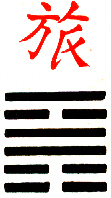
Above; fire, brightness
Below; mountain, stillness
The mountain is
unmoving while the fire burns upward. The two trigrams
have nothing to hold them together and so represent
the separation that is the fate of the wayfarer.
Lu, the wayfarer
signifies success in small matters. Perseverance brings
good fortune to the travelling man.
The weak yin line
in the centre of the upper trigram is freely subservient
to the yang lines on either side of it. The obstinacy
represented by the mountain, conjoined to the beauty
of the fire, indicates success in small matters and
the good fortune that will eventually come to determined
wayfarers. Great is the time and great the right course
indicated by Lu.
Fire upon the mountain
is the image of Lu. The Superior Man, accordingly
is wise and cautious in imposing penalties and does
not allow lawsuits to drag on.
Line 1
The journeyer concerns
himself with trifles and so attracts calamity.
The traveller upon
the way should not demean himself or bother with unimportant
matters. He is himself humble and defenseless and
so it is even more important to preserve his spiritual
dignity. It is most important to avoid the disputes
he finds along the road. Good fortune.
Line 2
The journeyer reaches
an inn. His valuables safe in his bosom, he finds
a young servant loyal to him.
The wayfarer is
well-behaved and keeps to himself. Preserving his
spiritual dignity, he finds a suitable resting place.
In this way, he not only retains the respect of others
and his own material prosperity, but he wins the allegiance
of a trustworthy follower.
Line 3
Careless, he burns
down the inn and loses his loyal servant. Though firm
and correct, he is in danger.
The wayfarer is
rude and ill mannered. Entirely by his own fault he
loses his lodging and possibly his belongings as well
as the loyalty of those who follow him. Whatever his
plans, it would be folly to attempt to proceed with
them at this moment.
Line 4
The wayfarer finds
a roadside shelter. He earns his living and acquires
an axe. But still he laments that his heart is not
glad.
The traveller modestly
restricts his ambition to what he can immediately
achieve. He makes a living and is, at least, temporarily,
established in the community where he finds himself.
But he is nonetheless a stranger, and must defend
himself. He has not found a home.
Line 5
He shoots at a
pheasant but loses his arrow. However, in the end,
he wins praise and gains high office.
The wayfarer, who
has arrived near the court of the prince, tries to
shoot a pheasant as gift for his host. But although
he is unsuccessful in this, and suffers a minor loss
as a result, he eventually receives great benefits.
Line 6
The bird burns
its own nest.
At first
the wayfarer laughs and then he cries and weeps. Careless,
he loses his cow. Misfortune.The bird burning its
own nest is the phoenix, a symbol to the Chinese of
high virtue. Yet, at the same time there is a suggestion
in this text that carelessness is responsible for
the burnt nest. The journeyer who sees it at first
behaves irresponsibly, laughing at what he conceives
to be the misfortune of another. But then he experiences
his own misfortune. The Chinese commentators imply
that the loss of a cow through carelessness means
that no news will ever be received of something lost.
© 1979 Neil
Powell
Back
To Top

 Hexagram 57
 Hexagram 55
Back to Consult Page
Back to Link Page
I Ching Mainpage
|