| 
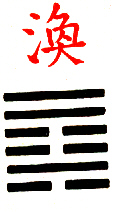
Above; wind, gentleness
Below; water, dangerous pit
The wind blows
across the water, dispersing it into spume, mists,
and eventually drying it up. So a man’s energy,
which is dangerously dammed up within him, may be
released by gentleness.
Huan indicates
progress and success. The king approaches his ancestral
temple. It is advantageous to cross the great water.
Crossing the great water indicates not only a journey
of some sort, but an undertaking of any sort. It is
advantageous to be righteously persistent in all.
Successful progress
is symbolized by the strong yang line in the second
place which is not exhausted there. The weak yin line
in the fourth place is appropriately outside the lower
trigram. The fifth line above representing the king,
responds to it. The king approaching his ancestral
temple and occupying the centre of the upper trigram
is maintaining his position without any change of
mind.
One of the additional attributes of the upper trigram
is wood. The advantage of crossing the great water
derives from mounting upon a vessel of wood and great
success is the result.
The wind blowing
over the water is the image of Huan. So the kings
of old built temples in which to sacrifice to the
supreme being.
Line 1
He brings assistance
with the strength of a horse. Good fortune.
The wind over the
water can bring clouds and if they are not dispersed
by a constant wind they will bring rainstorms. At
such a time it is important to join together in vigorous
action before concealed divisions of opinion bring
about misunderstanding.
Line 2
In the midst of
dispersal he hastens to the altar. Regrets vanish.
The symbolism of
the upper trigram is of a temple in which one can
find shelter from the dangers of the pit below. The
implication is that one should find some spiritual
means of protection from the evil. The altar represents
the means that one has established to protect oneself.
Line 3
All self-interest
is dispersed. No regrets.
Only by a great
renunciation can a man obtain the strength to achieve
great things. He must put aside all personal desires
that may come between him and the welfare of others.
He must set his sights on a goal outside himself.
Line 4
He disperses his
followers. Great good fortune. Dispersal leads to
accumulation. Good men standing like a mound. Something
that ordinary people would not have thought of.
The following who
are dispersed are those who have not proved themselves
equal to their tasks. ‘Cast thy bread upon the
waters for thou shalt find it after many days.’
The man of good intent who rids himself of incompetent
companions and who continues on his self-appointed
path of service to the community will soon be joined
by others of like mind.
Line 5
He issues his
proclamations as sweat flows from the body. The king
scatters is stores among the people without blame.
Just as a high
fever is dispersed in perspiration, so the king may
relieve his anxieties by dispersing his possessions
among the needy. Great and generous ideas are necessary
for success at this time.
Line 6
He disperses bloodiness.
He keeps evil at a distance. He departs without blame.
All the commentaries
upon this text disagree upon the precise meaning of
the words. But it seems clear that ‘dispersing
bloodiness’ means the avoidance of bloodshed
and removing oneself from the danger of injury.
© 1979 Neil
Powell
Back
To Top

 Hexagram 60
 Hexagram 58
Back to Consult Page
Back to Link Page
I Ching Mainpage
|