| 
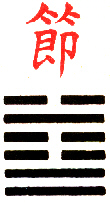
Above; dangerous,
deep water
Below; a pool of water, joy
The word Jie really
means the joints of the bamboo, or the joints of the
human frame, or the natural divisions of the year.
Thus it represents the voluntary limitations that
may be set upon growth or expenditure in order to
maintain matters in due moderation. The pool of water
can only occupy a limited space. The movement of more
water from above must be strictly restrained or the
pool will overflow.
Restraint brings
success and progress. But restrictions that are severe
and difficult should not be perpetuated.
Jie signifies success
because the strong yang lines and weak yin lines are
equal in number and there is a yang line in the fifth
position. Severe and difficult restrictions should
not be allowed to continue because they produce exhaustion.
Even in the midst of danger we experience pleasure
and satisfaction in following the proper course. It
is by the restraint exercised between terrestrial
and celestial forces that the four seasons arrive
each at its appointed time. So, when due restraint
is shown in the duties of government, the state suffers
no injury and the people no hurt.
Water above the
pool is the image of Jie. The Superior Man accordingly
creates his system of number and measure. He discusses
the nature of virtue and proper conduct.
Line 1
He restricts himself
to the outer gates and courtyard. No blame.
The man who knows
rightly how to limit his undertakings in the face
of insuperable obstacles can accumulate an energy
that, at the right moment, will enable him to act
positively. Confucious says: ‘Where disorder
develops, words are the first steps. If the prince
is not discreet, he loses his servant. If the servant
is not discreet, he loses his life. Therefore, the
Superior Man is careful to maintain silence and does
not go forth.’
Line 2
He restricts himself
to the courtyard within his gate. Misfortune.
When the time for
action arrives, it is essential to act at once. As
water flows into a pool, so there comes a moment when
it must find an outlet.
Line 3
He places no restrictions
upon himself. Lamentations. But no blame.
Those who give
themselves up to indulgence may well have cause to
regret it. But provided they are prepared to accept
the responsibility for their actions they are not
to be condemned.
Line 4
He restrains himself
contentedly. Success.
This text needs
no further elucidation.
Line 5
He restrains himself
sweetly and voluntarily. Good fortune. Going forward
brings approbation.
This is a very
important line. The strong yang line is in the position
of the ruler. When a man in an important position
applies necessary restraints to his own actions, without
demanding too much from his associates, then his modesty
will bring good fortune. It will be possible to advance
with general approval.
Line 6
Troublesome restraint.
Persistence brings misfortune but there is no regret.
Restrictions
that are too severe will not be endured for long.
Even the ascetic’s body will eventually rebel
against self-torture. Nevertheless, on occasions a
certain ruthlessness toward oneself is the only way
to salvation.
© 1979
Neil Powell
Back
To Top

 Hexagram 61
 Hexagram 59
Back to Consult Page
Back to Link Page
I Ching Mainpage
|