| 
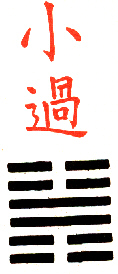
Above; thunder
and awakening
Below; mountain and stillness
This hexagram represents
a most unusual situation. Weak yin lines enclose it
on both sides and are dominant. But the two strong
yang lines are at the centre. These yang lines exert
their influence, creating conflict and exceptional
conditions. But it is the yin lines which must relate
to the external world. A man who attains a position
of authority for which he is not really adequate must
exercise unusual prudence.
The small persist.
Success. Righteous perseverance brings its just reward.
Small things may be accomplished but the time is not
right for great things. Birds fly high, singing, but
lose their tune. It is better not to strive upward
but to stay below.
This hexagram indicates
success for the small. Their persistence will be rewarded,
and their deeds fit the times. The yin line in fifth
place signifies success in small affairs and good
fortune. The yang lines in fourth place has not succeeded
in reaching a ruling position, indicating that it
is not the moment for great matters. The symbol of
a bird denotes that it is better to descend than to
ascend. This is the way to good fortune.
Thunder upon the
mountain is the image of Xiao Guo . The
Superior Man accordingly shows excess in his reverence,
too much grief in his bereavement and too much economy
in his husbandry.
Line 1
The bird flies
upward and meets misfortune.
The young bird
that flies too soon, before it is fully fledged is
courting disaster. Exceptional measures should only
be taken when there is nothing else left.
Line 2
Passing by the
ancestor and meeting the ancestress: failing to see
the prince but encountering a minister. No blame.
In the temple,
the grandson stands on the same side as the grandfather.
To pass by the tablets of the male ancestor, going
toward those of the ancestress is unusual, but it
still shows the proper reverence and humility. In
the same way it is proper, having failed to secure
a meeting with the prince, to make an appointment
with one of his ministers.
Line 3
Take unusual precautions
for subordinates may come from behind to strike you.
Misfortune.
At certain times
extraordinary caution is necessary. There are many
who, conscious of their righteousness, think it petty
to keep on their guard against subterfuges of their
subordinates. But the wise man is vigilant at all
times.
Line 4
No blame. He meets
him in his path and does not slip by. Going forward
brings danger. Be on your guard. Now is not the time
for action but for constant determination.
The yang line is
not in a dominant position. Although it tries to exert
its force, there is no blame if the correct course
is taken. Nevertheless, all opposition and obstacles
in the path must be met face on. This is not the time
for pushing forward.
Line 5
Dense clouds but
no rain from the western marches. The prince shoots
his arrow hitting the man in the cave.
The image of the
bird has become that of high flying clouds. But though,
they are dense, no rain falls. This suggests that
what is to come from the west is not misfortune. The
fifth line represents the prince but the two yin lines
at the top represent a cave. A man in authority exercises
the powers that have been given to him, but in doing
so he exceeds his abilities and injures another who
represents no threat to him.
Line 6
He passes by not
facing him. The bird flies away, meaning misfortune,
calamity and injury.
To go by,
not acknowledging the existence of obstacles is arrogant.
Overshooting the target, one misses it. The bird escapes,
but only to encounter a more successful hunter. Small
things prosper, but pushing forward only brings down
upon oneself misfortune and pain.
© 1979
Neil Powell
Back
To Top

 Hexagram 63
 Hexagram 61
Back to Consult Page
Back to Link Page
I Ching Mainpage
|