| 
Above; dangerous
deep water
Below; fire, brightness
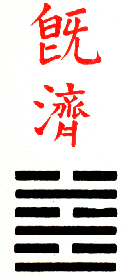
This hexagram represents
an evolutionary phase of hexagram 11 (Tai –
Peace). The strong yang lines have moved upward into
their appropriately strong positions. They have displaced
the yin lines into their proper weak positions. Everything
is in its proper place. But although this is a very
favourable hexagram, it still gives grounds for caution.
It is when equilibrium has been reached that any sudden
movement may cause order to revert to disorder.
After the climax
there is success in small matters. Righteous persistence
brings its reward. Good fortune in the beginning,
but disorder in the end.
Ji Ji indicates
progress in small matters. The proper position of
the yang and yin lines shows that righteous persistence
will be rewarded. The weak line at the centre of the
lower trigram indicates good fortune in the beginning,
but the way peters out. Efforts come to an end and
disorder returns.
Water over the
fire is the image of Ji Ji. The Superior Man accordingly
gives due thought to the misfortunes to come and takes
precautions in advance.
Line 1
Like a driver who
brakes his chariot or a fox with a wet tail. No blame.
When all things
are pressing forward, the wise man does not allow
himself to be carried away by the general fever of
enthusiasm. He may not entirely unaffected by the
disasters that overwhelm his companions, but he is
like a fox who, having safely crossed the water, has
got only his tail wet.
Line 2
She loses her carriage
curtain. Do not run after it. In seven days it will
be recovered.
In China it as
breach of propriety for a woman to drive in a carriage
without a curtain. This hexagram represents someone
who does not have the confidence of those in authority
above him, although he feels her deserves it. His
first thought will be to try to draw attention to
himself, to seek further promotion. This is wrong,
for he should wait patiently until he is recognized
for what he is.
Line 3
The illustrious
Ancestor, the emperor Wu Ting attacked the country
of the devils. Three years he took subduing it.
Small men are not
fit for such enterprises. Wu Ting was one of the ablest
of the Shang dynasty. He led an expedition against
the barbarous tribes on his northern borders about
1324 B.C.. When peace and stability have been achieved,
there is almost always some rebellious influence which
must be overcome. Frequently a tedious and bitter
struggle ensues and only a great man is suitable for
the task.
Line 4
The finest clothes
turn to rags. Be careful all day long.
The wise man is
not deceived by present prosperity. He knows that
even the best things deteriorate and must be renewed.
So he constantly is on his guard against misfortune.
Line 5
The neighbour in
the east sacrifices an ox.
But it is the neighbour in the west, with his small
sacrifice who is blessed for his sincerity.
The neighbour in
the west does not make ostentatious gestures. At the
right moment, he makes his offering with proper sincerity
and so gains good fortune.
Line 6
His head is in
the water. Misfortune.
The man who has
safely crossed water, and then gets his head wet,
can only have done so by turning back. If he goes
forward without looking back, however, he will escape
misfortune.
© 1979 Neil
Powell
Back
To Top

 Hexagram 64
 Hexagram 62
Back to Consult Page
Back to Link Page
I Ching Mainpage
|